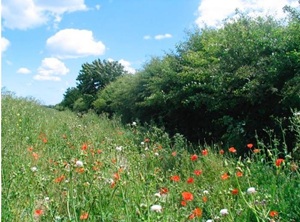
Certain hedgerows have been protected since 1997 when the Hedgerows Regulations came into force. To preserve these environmentally valuable features it is prohibited to remove all or part of a hedgerow that meet criteria for length, location, and importance.
To find out further information regarding protected trees and high hedges refer to the relevant webpage.
For any other information relating to trees and hedges refer to the relevant webpage.
Criteria
Criteria from any of the following sections must be met for a hedgerow to be lawfully protected.
Length
- More than 20m long with gaps of less than 20m within
- Less than 20m long but meets another hedge at each end
Location
The hedge may be on or next to:
- land used for agriculture or forestry
- land used for breeding or keeping horses, ponies or donkeys
- common land
- a village green
- a site of special scientific interest
- a protected European site, such as a Special Protection Area or Special Area for Conservation
- a local or national nature reserve
- land belonging to the state
Importance
A hedgerow may be termed important if it is 30 years old or older and has one of the following features:
- mark all or part of a parish boundary that existed before 1850
- contain an archaeological feature
- is completely or partly next to an archaeological site listed on a Historic Environment Record (HER)
- marks the boundary of an estate or manor that existed before 1600
- is part of a field system that looks to be related to any building or other feature associated with the field system that existed before 1845 - reword
- contains protected species listed in The Wildlife and Countryside Act 1981
- contains species that are endangered, vulnerable and rare identified in the British Red Data books
- includes woody species and associated features as specified in Schedule 1, Part II Criteria, paragraph 7(1) of the Hedgerow Regulations