Anti-Bribery Policy

Bribery is a criminal offence under the Bribery Act 2010. The council does not, and will not, pay bribes or offer improper inducements to anyone for any purpose, nor do we or will we, accept bribes or improper inducements.

To use a third party as a conduit to channel bribes to others is a criminal offence. We do not, and will not, engage indirectly in or otherwise encourage bribery.

We are committed to the prevention, deterrence and detection of bribery. We have a zero-tolerance towards bribery and we aim to maintain anti-bribery compliance as ‘business as usual’ rather than a one-off exercise.

Contents

Objectives

  1. This policy provides a framework to enable the council’s employees, councillors and associated persons to understand and implement arrangements enabling compliance. In conjunction with related policies and key documents it will also provide guidance to enable employees, councillors and associated persons to identify and effectively report a potential breach.
  2. We require that all councillors, employees and contractors:
  • Act honestly and with integrity at all times and to safeguard the council’s resources for which they are responsible.
  • Comply with the spirit, as well as the letter, of the laws and regulations of all jurisdictions in which the council operates, in respect of the lawful and responsible conduct of activities.

Scope

  1. This policy applies to all of the council’s activities and all employees, councillors and associated persons (including permanent and temporary employees, agency staff, contractors and councillors).
  2. For partners, joint ventures and suppliers, we seek to promote the adoption of policies consistent with the principles set out in the policy.
  3. Within the council, the responsibility to control the risk of bribery occurring resides at all levels of the organisation.

The council’s commitment to action

  1. The council commits to:
  • Set out a clear anti-bribery policy and keep it up to date.
  • Make all employees, councillors and associated persons aware of the policy and procedures and their responsibilities to adhere strictly to this policy at all times.
  • Encourage its employees, councillors and associated persons to be vigilant and to report any suspicions of bribery, providing them with suitable channels of communication and ensuring sensitive information is rated appropriately.
  • Rigorously investigate instances of alleged bribery and assist police and other appropriate authorities in any resultant prosecution.
  • Take firm and vigorous action against any individual(s) involved in bribery.
  • Provide information to all employees, councillors and associated persons to report breaches and suspected breaches of this policy.
  • Include appropriate clauses in contracts to prevent and deter bribery.

The Bribery Act 2010

  1. Bribery is an inducement or reward offered, promised or provided to gain personal, commercial, regulatory or contractual advantage.
  2. There are four key offences under the act:
  • Bribery of another person (section 1) to induce or reward them to perform a function improperly.
  • Request or accept a bribe (section 2) as a reward for performing a function improperly.
  • Bribing a foreign official (section 6) to gain a business advantage.
  • Failing to prevent bribery (section 7) is a corporate offence for the failure by a commercial organisation to prevent bribery

3. Under section 7, an organisation will have a defence to the corporate offence if it can demonstrate that it had in place adequate procedures to prevent bribery by or of persons associated with the organisation.

Is the council a ‘Commercial Organisation’

  1. The Bribery Act 2010 states that a ‘commercial organisation’ is a body or partnership incorporated or formed in the United Kingdom, and Ministry of Justice guidance clarifies this as meaning “…it does not matter if it pursues primarily charitable or educational aims or purely public functions. It will be caught if it engages in commercial activities, irrespective of the purpose for which profits are made.”
  2. For the purposes of the act the council is a ‘commercial organisation'.

Anti-bribery procedures

  1. In order to be able to provide a defence to any section 7 allegations, the council requires ‘adequate procedures’ to be in place.
  2. The term ‘adequate procedures’ is not defined in the statute. It is for each organisation to determine proportionate procedures. Ultimately, if bribery occurs, a court will decide whether the procedures are adequate.
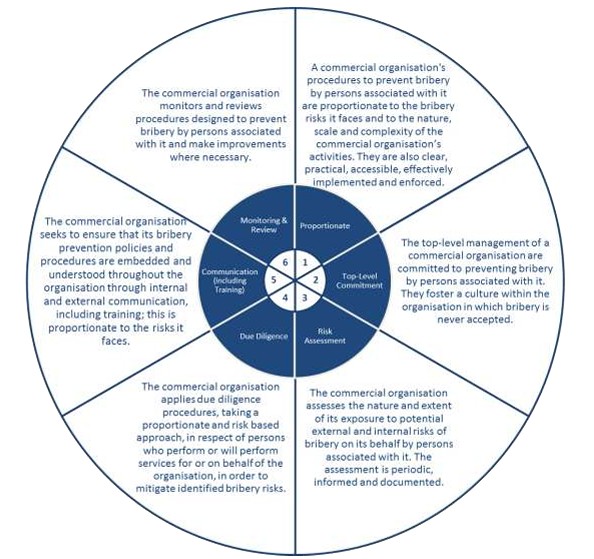
  3. In determining procedures, there is a need to have regard to the following six principles which are set out in guidance produced by the Ministry of Justice.Anti-bribery procedures_2026

Penalties

  1. An individual guilty of an offence under section 1, 2 or 6 of the Bribery Act 2010 can be subject to:
  • Imprisonment up to 12 months and/or a fine (on conviction in a magistrates court)
  • Imprisonment up to 10 years and/or an unlimited fine (on conviction in a crown court).

2. An organisation guilty of an offence under section 7 the Bribery Act 2010 can be subject to:

  • An unlimited fine

Bribery is not tolerated

  1. It is unacceptable to:
  • Give, promise to give, or offer a payment, gift or hospitality with the expectation or hope that a business advantage will be received, or to reward a business advantage already given.
  • Give, promise to give, or offer a payment, gift or hospitality to a government official, agent or representative to ‘facilitate’ or expedite a routine procedure.
  • Accept a payment from a third party that you know or suspect is offered with the expectation that it will obtain business advantage for them.
  • Accept a gift or hospitality from a third party that you know or suspect that it is offered or provided with an expectation that a business advantage will be provided by the council in return.
  • Subject an individual to unwarranted treatment or threaten that person where they have refused to commit a bribery offence or who has raised concerns under this policy.
  • Engage in activity in breach of this policy.

Facilitation payments

  1. Facilitation payments are unofficial payments made to public officials in order to secure or accelerate actions. Facilitation payments are illegal and will not be tolerated.

Gifts and hospitality

  1. From time to time councillors and officers are faced with the difficulty of deciding whether or not to accept offers of gifts or hospitality which arises during the course of their business activities.
  2. Guidance for councillors can be found in the ‘Code of Conduct for Councillors’ and guidance for employees can be found in the ‘Gifts and Hospitality’ policy.

Public contracts and failure to prevent bribery

  1. Under the Public Contracts Regulations 2015 (as amended), a company is automatically and perpetually debarred from competing for public contracts where it is convicted of a corruption or bribery offence. Currently the Regulations do not include the offence of failure to prevent bribery. Organisations that are convicted of failing to prevent bribery are not automatically barred from participating in tender for public contracts. However, the council has the discretion to exclude organisations convicted of this offence.

Employee and councillor responsibilities

  1. It is the responsibility of all employees and councillors to:
  • Ensure that they read, understand and comply with this policy.
  • Raise concerns as soon as possible if you believe or suspect that a conflict with this policy has occurred, or may occur in the future.

Raising a concern

  1. The council is committed to ensuring that all employees and councillors have a safe, reliable and confidential way of reporting any suspicious activity.
  2. We all have a responsibility to help detect, prevent and report instances of bribery. If you have a concern regarding a suspected instance of bribery, please speak up.
  3. You can either use the Whistleblowing Policy that can be found in the Staff Handbook or speak to the Fraud Team (also see Fraud Response Plan).
  4. In the event that an incident of bribery is reported to the Fraud Team, we will act as soon as possible to evaluate the situation. We have clearly defined procedures for carrying out investigations.
  5. Concerns can be reported to Fraud Team in whichever way is favoured:

Fraud Team, Basingstoke and Deane Borough Council, Civic Offices, London Road, Basingstoke, Hampshire, RG21 4AH

  • Personal visits can be made to Fraud Team on any pretext and discussion will be conducted in a meeting room or elsewhere as appropriate.
Version 1.3
Owner Head of Audit, Fraud and Insurance
Issue date January 2024
Next revision due January 2026

Sign up for email updates

Receive information on council services, news and events by email.

© 2026 Basingstoke and Deane Borough Council