Sherfield Park ancient woodland restoration project: A Place to ‘PAWS’ for Thought

Select image to open a larger version
In November 2023 work was undertaken to restore an area of ancient semi-natural woodland at The Larches at Sherfield Park.
The Larches woodland, like much of the other natural woodland in this area, is considered to be ancient semi-natural woodland, meaning the land has had continual tree cover since at least the 1600s, creating rich and complex habitats that have evolved to support a wide variety of unique species.
The reason for habitat restoration
After the Second World War, the Larches was cleared of its natural tree cover and replanted with beech and conifer as a timber crop. This practice was known as Plantation on Ancient Woodland Sites (PAWS).
Unfortunately, much of the current timber crop was at the end of its life span and in places is in poor condition. The plantation trees had become increasingly unstable creating a risk to property and public safety. This was exacerbated by Ash Die Back which was killing the mature ash on site.
Without this work and, as the trees had all reached the end of their lifespan, there was an increased risk of trees falling and causing damage or possible injury.
Work carried out
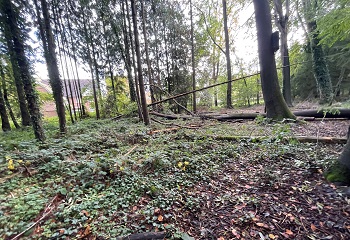
The work involved clearing all of the planted timber and replanting with a mix of native species that will be more representative of those found in ancient woodland. As the trees were all of a single age and were not strong enough to support themselves without the protection of other trees around them, it was not practical in this instance to take a phased approach to removal.
Restoration of Plantation on Ancient Woodland Sites is important as it improves woodland biodiversity and will, in time, support the recovery of wildflowers, birds, mammals and insects that were displaced when the natural tree cover was removed.
More information on the importance of Plantation on Ancient Woodland Sites restoration is available from the Woodland Trust Ancient Woodland Restoration - Woodland Trust
Replanting the woodland
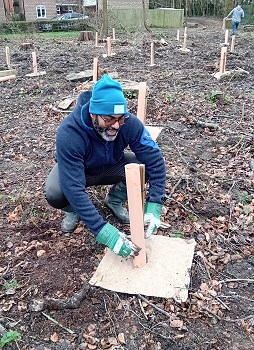
Following the felling phase of work, events were held at the beginning of 2024 to replace Sherfield Park’s native trees. With a turnout of over 100 volunteers we managed to plant up to 1,000 trees.
We planted a mix of native trees that would have previously been on the site. Species include oak, hazel, cherry, hawthorn, small-leaved lime, spindle, field maple and crab apple.
- Why we only plant small saplings
-
Studies have shown that young saplings have a much higher success rate. Mature trees are more likely to suffer transplant shock, resulting in the plant failing to root.
Younger trees grow rapidly and will match the size of bigger saplings in under 10 years. Having a good start means they are much more likely to have a strong and healthy future and less likely than older trees to succumb to disease or fall in high winds.
- Watering the trees
-
We can’t water every newly planted tree in a woodland, but we can help them to retain as much moisture as possible.
The tree tubes which surround the trees help to maintain a moist microclimate that will encourage strong growth and protect the young tree from dry spells. They also offer protection from grazing deer, who find young tree tips irresistible.
Mulch mats keep thirsty weeds away from the roots.
We expect that some trees will fail to grow and the amount of planting has been planned with losses in mind. We have spare saplings to add at a later stage in case an extreme dry spell results in a high number of losses.
- Biodegradable tree tubes
-
The tubes are made of a biodegradable material that will break down naturally in time once they’ve fulfilled their protective role.
Deadwood: A haven for wildlife
Historically all wood would have been removed from plantations so that it could be used, rather than being left to rot down. At Sherfield Park some dead trees have been left standing and fallen trees have been left as logs to keep the habitat healthy and diverse.
Wood that is left to rot down creates a whole microworld of habitats within habitats, supporting hundreds and ultimately thousands of species that it couldn’t necessarily support when the tree was alive. Fungi, mosses, lichens, beetles, slugs, snails are among many species benefitting from different stages of wood decomposition. Not just a resource for food but decaying wood also acts as a shelter for small rodents, reptiles, and amphibians. The years of nutrients that the tree stored within itself, will return to the soil, and create nutrients for other species and future or existing trees. It is estimated that of the species we know of, at least six thousand rely on deadwood.
Future work
Following the replanting, we will continue to lead on the restoration of The Larches in additional phases and careful, on-going monitoring will take place to record the recovery of these woodlands. If you have any further questions get in touch by emailing wildlifeconservation@basingstoke.gov.uk.
Getting involved in nature conservation in this area
If you are interested in supporting the Sherfield Park Ancient Woodland Restoration Project, getting involved with habitat management around Sherfield Park or learning more about local wildlife please contact sherfieldparkcg@gmail.com to express an interest in being part of a local community wildlife group or visit our Green space volunteering web page.
Sign up for email updates
Receive information on council services, news and events by email.
Subscribe© 2026 Basingstoke and Deane Borough Council