There are three main parts to our finances: revenue, capital and reserves.
Revenue funding pays for our day-to-day services. It is funded through income including our share of council tax, business rates, fees and charges, and income from commercial property and cash investments.
Unlike many other councils we have a strong commercial property and cash investments portfolio. The income we get from property we own is almost double the amount we get from council tax.
This is where every £10 of our £65.29 million revenue budget would come from:
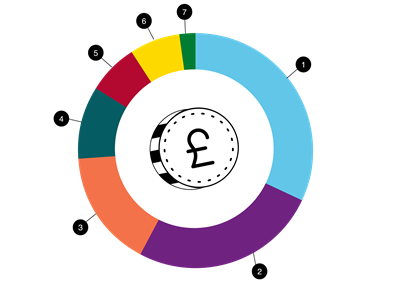
The amounts relating to each section of the graph are shown in the table below.
| No. | Income source | Amount |
|---|---|---|
| 1 | Commercial property rents | £3.20 |
| 2 | Fees and charges for council services and other service income | £2.60 |
| 3 | Council tax | £1.60 |
| 4 | Investment income | £1.00 |
| 5 | Government grants | 70p |
| 6 | Retained business rates | 70p |
| 7 | Other grants and contributions | 20p |
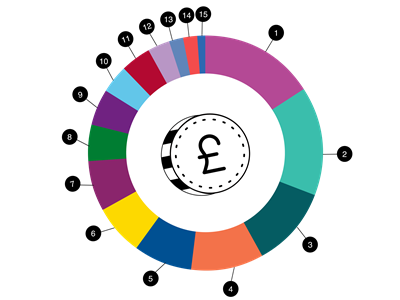
The amounts relating to each section of the graph are shown in the table below.
This is how every £10 would be spent on our services:
| No. | Service area | Amount |
|---|---|---|
| 1 | Waste and recycling | £1.60 |
| 2 | Planning and place shaping | £1.50 |
| 3 | Parks and open spaces | £1.10 |
| 4 | Commercial property | £1.00 |
| 5 | Other central services | 80p |
| 6 | Street cleaning | 70p |
| 7 | Housing and homelessness | 70p |
| 8 | Democratic and electoral services | 50p |
| 9 | Leisure, recreation and culture | 50p |
| 10 | Environmental protection and regulatory services | 40p |
| 11 | Community support and development | 40p |
| 12 | Car parks | 30p |
| 13 | Transport | 20p |
| 14 | Community safety | 20p |
| 15 | Economic and business development | 10p |
Capital funding is used to improve facilities, undertake large scale projects, investments and purchase property, which will provide income to help pay for our services.
We also have to hold funds to help with potential issues that could impact our ability to receive the income that we expect or have to incur additional expenditure. These are called reserves, with some of this money allocated for specific purposes. Reserves cannot be used to fund ongoing spending and are finite. The reserves we currently hold are equivalent to the money we spend on our services for six months.