Capital Investment Strategy 2026/27

1. Statutory Requirements

  1. The council is required by the Prudential Code of Practice to have an annual Capital Investment Strategy and prudential indicators and limits relating to capital expenditure, affordability, external debt and investments.
  2. This strategy must be approved by Council before the start of the financial year and be published on the council’s website.

2. Objectives

  1. The objectives of the Capital Investment Strategy for 2026/27, set out in this Appendix, are to provide a high-level overview of:
    • how capital expenditure, income and financing, along with all types of investment, contribute to the provision of public services, and
    • how the associated risks are managed and the implications for future financial stability.
  2. Included in this Strategy are the following key items that are subject to the approval of Full Council:
    • the Prudential Indicators for 2026/27 to 2029/30, which are set out as tables throughout the document;
    • the Annual Minimum Revenue Provision Statement for 2026/27 (see section 8 of this appendix); and
    • the Authorised Limit for External Debt of £60.00M for 2025/26 (see table 6 in section 10 of this appendix)

3. Capital Expenditure Plans

  1. Capital expenditure is money spent on assets that will be used by the council for more than one year. Examples include property, equipment, and vehicles. For local government this includes spending on assets owned by other entities where the council issues financing, by way of loans and grants, to those entities enabling them to incur capital expenditure.
  2. Total capital expenditure is a risk indicator required by the prudential code and the council’s capital expenditure plans over the medium term (detailed in the council’s Capital Programme and Strategy Update Report) are summarised in table 1, below:

Table 1 – Capital Expenditure

. Estimate 2025/26
£M
Estimate 2026/27
£M
Estimate 2027/28
£M
Estimate 2028/29
£M
Estimate 2029/30
£M
Estimate
Total
£M
Service-Based Capital Expenditure 15.16 16.71 14.56 8.38 4.71 59.52
Manydown 1.21 0.67 0.91 0.75 0.72 4.26
Redevelopment of Leisure Park 0.47 1.50 23.40 20.11 14.20 59.68
Investment Property 0.53 0.57 0.15 0.15 0.15 1.55
Property Investment Strategy 0.00 2.22 1.85 0.10 0.10 4.27
Total Capital Expenditure 17.37 21.67 40.87 29.49 19.88 129.28

The main service based capital projects by service include:

  • improvements to council-owned operational buildings, £11.62M;
  • home improvement financial assistance (disabled facilities grants), £9.36M;
  • environmental and sustainability initiatives including open spaces, £6.43M;
  • rolling IT and operational vehicle replacement programme, £5.94M;
  • housing and homelessness schemes, £3.68M;
  • replacement of waste collection vehicles to meet legislative changes, £6.78M;
  • play area improvements, £2.47M;
  • parking and access schemes, £1.41M;
  • improvements to sport and recreation schemes, £2.93M;
  • community Infrastructure Fund of £1.82M;
  • improvements to and new community facilities, £4.66M;
  • 5G Living Lab scheme, £1.41M; and
  • digital and transformation schemes, £0.42M.

3. The capital programme expenditure is monitored in the following ways:

  • monthly budget monitoring reports to budget managers and the senior leadership team (SLT);
  • quarterly reports to Cabinet including reporting of performance against Prudential Indicators; and
  • annual reports to Full Council.

4. To ensure that capital assets continue to be of long-term use, the council has a Strategic Asset Management Plan (SAMP) and ongoing revenue and capital budgets for maintenance, major repairs and enhancements.

5. The council will consider the impact of the capital programme on the council’s overall resources. This is a key indicator of affordability and is covered in section 7 of this Appendix.

6. The proposed capital programme is currently financed from revenue contributions, revenue and capital reserves, external grants and contributions, and short-term internal borrowing (this can only be temporary financing).

4. Capital Expenditure Approval Process

  1. The process for approving schemes for capital expenditure is set out in the Capital Programme Strategy which sets out how capital expenditure will help deliver the council’s long-term vision and council plan priorities and how capital resources are prioritised and funding decisions are made.
  2. The Capital Programme Strategy also sets out the funding streams for capital expenditure including capital receipts and contributions.

5. Capital Income

  1. When assets are no longer required, they may be sold so that the proceeds, known as capital receipts, can be spent on new assets or to repay debt. Repayment of capital grants, service loans and capital investments also generate capital receipts. Furthermore, the council receives grants and contributions useable towards capital expenditure.
  2. The council’s estimated capital income over the medium term is shown in table 2.

Table 2 – Capital Receipts and Income Estimates

. Estimate 2025/26
£M
Estimate 2026/27
£M
Estimate 2027/28
£M
Estimate 2028/29
£M
Estimate 2029/30
£M
Estimate
Total
£M
Asset Sales 8.85 1.06 2.06 1.02 1.04 14.03
Loans Repaid 0.69 0.32 0.06 0.15 0.12 1.34
Total Capital Receipts 9.54 1.38 2.12 1.17 1.16 15.37
Capital Grants (Better Care Fund) 1.94 1.94 1.94 1.94 1.94 9.70
Other Grants and Contributions 2.29 0.41 0.59 0.05 0.08 3.42
Developers Contributions 0.50 0.66 0.66 0.65 0.00 2.47
Community Infrastructure Levy (Retained Strategic CIL) 4.14 2.94 2.94 2.95 2.95 15.92
Total Grants and Contributions 8.87 5.95 6.13 5.59 4.97 31.51
Total 18.41 7.33 8.25 6.76 6.13 46.88

3. The amount of gross new capital receipts assumed in the financial forecasts total £15.37M during 2025/26 to 2029/30. This includes gross receipts of £5.50M in respect of the land at Manydown, a forecast of £7.10M for sales of property under the Property Investment Strategy and an anticipated partial receipt of £1.00M linked to the reprovision of the golf site. In addition there is £0.43M from sales of council owned vehicles, loan repayments related to service-based loans e.g. waste vehicles £0.95M and low cost home ownership £0.39M.

4. The amount of new capital grants and contributions assumed in the financial forecasts total £13.12M during 2025/26 to 2029/30. This includes government grants to fund disabled facilities grants of £9.69M, the local authority housing fund £0.64M and the UK Prosperity Fund and Rural England Fund initiatives of £0.17M. In addition there is partner funding from Hampshire County Council (legacy EM3 LEP funding) of £0.93M for the 5G Living Lab scheme and contributions from Hart District Council of £0.26M to fund vehicles delivering the shared services agreement for grounds maintenance and street cleansing. New grants include £0.22M from the Local Nutrient Migration Fund and an anticipated Football Foundation grant of £0.50M to part fund a proposed Rugby Pitch Artificial Grass Pitch at Down Grange. Furthermore, there is £0.47M in respect of property dilapidation works contributions from tenants and other small contributions totalling £0.24M account for the balance of contributions.

5. The forecast new receipts from S106 developer contributions is £2.47M during the period 2025/26 to 2029/30.

6. Income from the Community Infrastructure Levy (CIL, introduced in July 2018) provides a significant future income stream to the council. This will fund priority community infrastructure requirements arising from new development. The estimated total income from CIL over the next 10 years will average £4.00M per year. After allowing for administration costs, allocations of Neighbourhood CIL to parishes and town areas with no parish council and making 20% (£0.59M) available to partner organisations eg Hampshire County Council and the Integrated Care Board, the council will retain approximately £2.36M of strategic CIL each year.

6. Capital Financing

  1. All capital expenditure must be financed, either from external sources (government grants and other contributions), from the council’s own resources (reserves and capital receipts) or from new debt (borrowing and leasing). The planned financing of the expenditure set out table 1 is shown in the following table 3, below:

Table 3 – Capital Financing

. Estimate
2025/26
£M
Estimate
2026/27
£M
Estimate
2027/28
£M
Estimate
2028/29
£M
Estimate
2029/30
£M
Estimate
Total
£M
External Sources            
Grants and Contributions 5.12 3.25 2.53 1.99 2.00 14.89
S106 Developers' Contributions 2.26 2.00 1.66 1.02 0.00 6.94
Community Infrastructure Levy 0.47 2.43 11.53 2.84 1.01 18.28
Own Resources            
Capital Receipts 7.96 11.61 6.42 16.35 1.15 43.49
Revenue Contributions 0.68 2.00 18.14 6.89 5.72 33.43
Debt (CFR)            
Internal Borrowing - Manydown (B Loan Note) 0.88 0.38
0.59 0.40 0.34 2.59
Internal Borrowing ( Redevelopment of the Leisure Park) 0.00
0.00 0.00 0.00 9.66 9.66
Total Capital Expenditure 17.37 21.67 40.87 29.49 19.88 129.28

2. The proposed future capital programme will be financed from within the council’s existing resources. However, any unfinanced capital expenditure from capital resources is deemed to be “internal borrowing” or debt even if the council does not need to externally borrow by taking out loans (for example, where the council has the resources to use internal cash balances in place of external loans). By the end of 2029/30 the estimated level of internal borrowing will be £13.70M (includes £1.45M in 2024/25) and relates to repayable Manydown service based capital loans (£4.04M) and costs associated with the Redevelopment of the Leisure Park (£9.66M).

3. The council’s MTFS processes must also reflect the IFRS 16 accounting standard. The standard requires the council to recognise a “right-of-use” asset for any arrangement where the council is granted exclusive rights to use an asset. This recognition is treated as capital expenditure financed by leasing, which increases the Capital Financing Requirement (CFR). To date the council has added one right-of-use asset to the balance sheet, however, as the lease is for nil consideration, the CFR is unaffected.

4. Debt is only a temporary source of finance since borrowing and leases must be repaid. The council’s cumulative outstanding amount of debt finance is referred to as the Capital Financing Requirement (CFR) and is a prudential code indicator. The CFR increases with capital expenditure or leases being recognised and reduces when capital receipts and contributions are used to reduce debt. By the end of 2026/27 the council is forecasting a CFR of £2.71M in respect of the Manydown loans and has historically not had any significant external debt.

5. In the case of internal or external borrowing, regulations dating back to 2003 and updated in 2024, require that a charge, or provision, is made in the revenue budget to either set aside monies to repay external debt or to restore balances used for internal borrowing. This is known as making a Minimum Revenue Provision and will impact the General Fund revenue budget.

6. The council’s annual Minimum Revenue Provision Policy Statement is set out in section 8 of this Appendix. In accordance with the policy, no MRP will be charged in respect of the Manydown service based loans as the loans are secured and will be repaid. There will be a future requirement beyond 2029/30 to charge MRP in respect of the Redevelopment of the Leisure Park starting the year after the asset becomes operational and this will be charged over 50 years. The CFR and MRP are reviewed annually and should new capital receipts be received they will be used to reduce the CFR which will reduce the annual MRP charge made.

7. However, should either internal or external borrowing be needed for additional future unfinanced capital expenditure, additional capital receipts will be required, or the council will need to set aside an increased MRP. The impact of such potential additional borrowing on future budgets would need to be observed to ensure affordability in the longer-term.

8. The following table (table 4) shows the CFR prudential indicator as it accumulates year-on-year. The purpose of this prudential indicator is to ensure that the level of unfinanced capital expenditure remains within sustainable limits.

Table 4 – Capital Financing Requirement (CFR) and Minimum Revenue Provision (MRP)

. Estimate
31/03/26
£M
Estimate
31/03/27
£M
Estimate
31/03/28
£M
Estimate
31/03/29
£M
Estimate
31/03/30
£M
CFR - Manydown Loans 2.33 2.71 3.30 3.70 4.04
CFR - Redevelopment of the Leisure Park 0.00 0.00 0.00 0.00 9.66
MRP 0.00 0.00 0.00 0.00 0.00

7. Overall Resources

  1. The council’s capital expenditure, capital income and financing plans will significantly reduce the council’s overall resources available to fund future capital schemes. The council’s overall available capital resources are forecast to reduce from £83.24M to £22.82M by March 2030.
  2. This includes the impact of making an annual revenue contribution to capital of £4.00M (via contributions to revenue reserves) over the medium term as part of the revenue budget strategy for 2026/27 to 2029/30 in order to generate capital resources to help fund future programmes. This also assumes that all current capital spending plans are met.
  3. The council has reviewed all its existing capital programme commitments to ensure that they still align with the Council Plan priorities.
  4. All future additions to the capital programme will need to have a robust business case that identifies how the scheme can be financed and how the borrowing costs and Minimum Revenue Provision are affordable and met from revenue budgets.

8. Annual Minimum Revenue Provision Policy Statement for 2026/27

  1. Capital expenditure that has not been financed from the council’s resources is deemed to be financed from borrowing. That borrowing may be either external or internal in nature. External borrowing is obtained from external entities (such as banks, local authorities, etc). Where the council has adequate cashflow balances in the form of realisable investments, those balances may be applied to finance borrowing, which is referred to as internal borrowing. In the case of internal or external borrowing, regulations dating back to 2003 (amended in 2024) require that a charge, or provision, is made in the revenue budget to either set aside monies to repay external debt or to restore balances used for internal borrowing. The amounts set aside (the provision) broadly correspond to the length of time that assets are employed by the council. Simply put, it spreads the capital cost to the local taxpayer over the expected life of a given asset.
  2. Unfinanced capital expenditure therefore adds to the council’s Capital Financing Requirement (CFR). As monies are set aside from revenue each year, those amounts accumulate and subsequently reduce the balance of the CFR. The provision made within the revenue budget for offsetting internal and external borrowing is called the Minimum Revenue Provision (MRP).
  3. Where the council is proposing to internally borrow against its cash resources for a service-based loan to other bodies, no MRP will be charged. This is because repayments made to the council will be deemed as representing the repayment of that financing and, therefore, satisfy the MRP need. MRP will be charged in the event there is a loss under IFRS 9 and will be made in the year that the loss is recognised.
  4. For any CFR falling outside service-based loans, MRP will be determined by charging the expenditure over the expected useful life of the relevant asset in equal instalments starting in the year after the asset becomes operational. MRP on purchases of freehold land will be charged over 50 years. MRP on expenditure not related to fixed assets, but which has been capitalised by regulation or direction, will be charged over 20 years.
  5. Adding assets recognised under IFRS 16 to the Balance Sheet has the effect of adding to the overall CFR. Therefore, in applying MRP principles to finance leases that meet the IFRS 16 definitions, the council considers it prudent that the MRP is represented by the rate at which payments are made to meet the annual liability for principal (this being a variable sum resulting from the discounting computations for each asset, as required by the IFRS 16 standard). The outcome is that the overall impact on the revenue budget is negated. MRP shall not be considered in the commencement year for assets designated as leased under IFRS 16 (for example, the first year of lease financing).

9. Borrowing Requirement and Strategy for 2026/27

  1. The council’s cash resources are forecast to fall from £107.74M to £34.09M by the end of 2029/30 as capital receipts, contributions and reserves are used to finance the capital programme and revenue reserves are used to support the revenue budget. The profile of cash resources and borrowing is set out in table 5, below.

Table 5 – Capital Financing Requirement (CFR), Internal Borrowing and Net Investment

. Estimate
31/03/26
£M
Estimate
31/03/27
£M
Estimate
31/03/28
£M
Estimate
31/03/29
£M
Estimate
31/03/30
£M
CFR 2.33 2.71 3.30 3.70 13.70
Less: external borrowing 0.00 0.00 0.00 0.00 0.00
Internal Borrowing 2.33 2.71 3.30 3.70 13.70
Balance Sheet resources (110.07) (96.40) (69.28) (45.72) (47.79)
Net Borrowing / (Investments) (107.74) (93.69) (65.98) (42.02) (34.09)

2. As part of the Capital Programme updated for the period to 2029/30 there is currently no identified need to fund capital spend through external borrowing. This is because the council has sufficient cash resources and can effectively “internally borrow” in the short term if required. If a need to externally borrow should arise, the council can access a variety of external borrowing platforms. One of these would normally have been the Public Works Loan Board (PWLB, which is operated by HM Treasury). However, the council’s ability to borrow from the PWLB is impacted by its current non-treasury investments which generate an income return for the council. The council’s approach to its property investments is covered in the following paragraphs.

3. Were the council to consider borrowing to finance investment in the future it is important to note that HM Treasury (HMT) issued a circular (no.162) in November 2020 to outline the new terms for lending to local authorities and these new terms are enshrined in the 2022/23 Prudential Code. The main features of the lending terms are:

a) Local authorities will be asked to submit a high-level description of their capital spending and financing plans for the following three years, including their expected use of the PWLB;

b) As part of this, the PWLB will ask the Chief Financial Officer to confirm that there is no intention to buy investment assets primarily for yield at any point in the next three years;

c) Recognising that it is not possible to reliably link particular loans to specific spending, this restriction applies on a ‘whole plan’ basis – meaning that the PWLB will not lend to a local authority that plans to buy investment assets primarily for yield anywhere in their capital plans, regardless of whether the transaction would notionally be financed from a source other than the PWLB;

d) When applying for a new loan, the local authority will be required to confirm that the plans they have submitted remain current and that the assurance that they do not intend to buy investment assets primarily for yield remains valid.

4. In practice any plan to buy or construct investment assets primarily for a financial return (for example, for yield), regardless of whether or not there are plans to borrow from the PWLB for that specific investment, would mean that PWLB funds could not be accessed. The impact of this is that funds have to be sought from elsewhere, most likely at less preferential rates and/or a higher risk. Alternatively, other sources of funds, such as capital receipts and revenue financing, would need to be identified to finance capital expenditure. It also means that the expected rate of return on any investment would need to be greater to compensate, principally for additional borrowing costs.

10. Authorised Borrowing Limit

  1. The Prudential Code requires the council to set external debt indicators which relate to the amount that the council can prudently borrow. These are shown in Table 6.

Table 6 – External Debt Indicators

. 2025/26 2026/27 to 2029/30
Authorised limit for external debt £60.00M £60.00M
Operational boundary for external debt £35.00M £35.00M

2. Under Section 3(1) of the Local Government Act 2003 the council is required to set an authorised limit for external debt. This limit is a statutory limit and is gross of investments. It represents the maximum limit for external borrowing both in the long term and for cash flow and treasury management purposes. The limit is based on a prudent but not worse case estimate with sufficient headroom to allow for operational management.

3. There are no proposed changes to either the Authorised Limit or Operational Boundary. The operational boundary for external debt is based on the same estimates as the authorised limit for external debt but represents the estimate of normal activity without the additional headroom included in the authorised limit.

4. The code of practice specifies that over the medium-term net borrowing will only be for a capital purpose. This is demonstrated by ensuring that, except in the short term, net external borrowing should not exceed the total Capital Financing Requirement in the previous year plus the estimates of any additional Capital Financing Requirements for the current and the next two financial years.

5. The Prudential Code requires that medium-term debt is only to be used for capital purposes. Adherence to this requirement is demonstrated by a comparison of gross debt with the Capital Financing Requirement (CFR).

This is a key indicator of prudence whereby the following condition should be met:
Gross debt does not, except in the short-term, exceed the total of capital financing requirement in the preceding year plus the estimates of any additional capital financing requirement for the current and next two financial years. Over the medium-term this control ensures that debt will only be obtained for capital purposes.

6. Table 7, below, confirms for BDBC that the condition is met:

Table 7 – Gross Debt and Capital Financing Requirement (CFR)

. Estimate
31/03/26
£M
Estimate
31/03/27
£M
Estimate
31/03/28
£M
Estimate
31/03/29
£M
Estimate
31/03/30
£M
Gross Debt (External Debt and IFRS16 Lease Liabilities) 0 0 0 - -
Estimated annual measure of
CFR
2.33 2.71 3.30 3.70 13.70
CFR - increase at the end of the current and next two financial years 3.30

3.70
13.70 - -
Excess External Debt above
CFR
nil nil nil - -
Condition met (yes/ no) yes yes yes - -

11. Investments

  1. The council has a significant number of investments. For this report investment means all financial instruments and assets that are used primarily to make a return. This means it includes the council’s entire investment property portfolio.
  2. The council invests for three purposes:
    • for the prudent management of surplus cash resulting from its day-to-day income and payments activities plus cash that it holds pending the council’s spending plans; investments for this purpose are known as Treasury Management investments
    • to support local public services by lending to other organisations (referred to as service-based investments)
    • to generate investment income from rents or interest (known as commercial investments where this is the main purpose)
  3. The council’s total investments are shown in Table 8, below:

Table 8 – Total Investment Exposure (including non-treasury investments and service-based loans)

.
Estimate
2025/26
£M
Estimate
2026/27
£M
Estimate
2027/28
£M
Estimate
2028/29
£M
Estimate
2029/30
£M
Treasury Management 107.74 93.69 65.98 42.02 34.09
Existing Investment Property 292.66 292.66 292.66 292.66 292.66
Property Investment Strategy (2022) 9.44 11.66 13.51 13.61 13.71
Manydown Loan Notes 28.46 28.13 28.04 27.79 29.51
Service-Based Investments 3.03 2.88 2.82 2.67 2.55
Total Investments 441.33 429.02 403.01 378.75 372.52

4. Whilst the overall aim of this strategy is to maintain the current overall level of property investment, the council, assisted by its property advisors (JLL), has identified a number of opportunities to generate improved long-term sustainable revenue by both working its existing capital asset base (for example, through disposals or re-gearing of leases) or by making new property investments from the capital sums generated by the former activity. The core aims and objectives of this strategy will be to achieve one or more of the following objectives:

  • generate improved sustainable revenue streams
  • diversify the existing asset base to reduce volatility and position for growth
  • modernise the estate and improve lot size
  • enhance the overall sustainability credentials of the portfolio towards net zero carbon
  • stimulate economic regeneration within the Basingstoke area

12. Treasury Management Investments

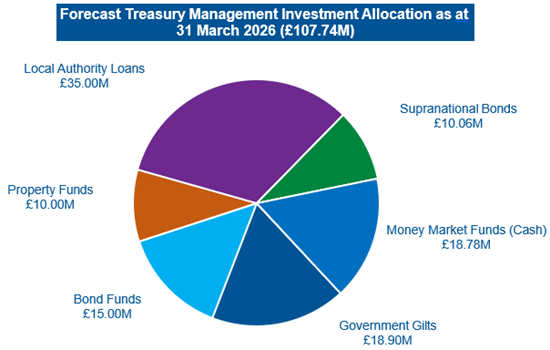
  1. The council is forecast to hold £107.74M of Treasury Investments as at 31 March 2026. A breakdown of the Treasury Investment Portfolio can be seen in Chart 1 – Estimated Treasury Investment Portfolio 31 March 2026Chart 1 – Estimated Treasury Investment Portfolio 31 March 2026

  2. Treasury Management investments are budgeted to contribute income of £4.41M to the revenue budget in 2026/27 and also ensure that cash is readily available to fund the council’s revenue and capital spending plans.
  3. There are various risks associated with treasury management. The main risks are as follows:
    • Credit and counterparty risk (risk to capital) – the risk that a third party will fail to meet its contractual investment obligation resulting in a loss of the council’s capital investment or the risk that there will be a permanent reduction in the capital value of the investment.
    • Liquidity risk – the risk that the council will commit too much of its investments in fixed term investments and might have to recall investments prematurely resulting in possible additional costs or losses upon disposal of tradable securities.
    • Market or interest rate risk – the risk that fluctuating interest rates will have an adverse impact on the council’s investment income or the value of its investments.
    • Other risks – this includes risks associated with cash management, legal requirements and fraud.
  4. The council’s risk appetite with regards to Treasury Management Investments is relatively low because the council follows the Government’s investment guidance which states that the risks should be measured in terms of Security, Liquidity and Yield (for example, returns), in that order. The council’s Treasury Management Policy Statement states that the primary objective is to invest prudently having regard to security and the secondary objectives are liquidity and obtaining optimum returns.
  5. Details on how these risks are managed and mitigated along with the governance arrangements for treasury management investments are contained within the council’s annual Treasury Management Strategy.

13. Non-Treasury Investments

  1. The council invests funds for both treasury and non-treasury purposes. The council’s treasury investments involve the placing of temporary surplus cash resulting from its day-to-day receipts and payments activities including, for example, earmarked reserves, capital receipts and income received in advance of expenditure. The council’s non-treasury investments comprise the following:
    • service-based investments - to support the delivery of local public services by lending to other organisations,
    • commercial investments, most-notably comprising investment property - to earn investment income to meet the wider needs of the council.
  2. Details of how these investments are managed, the contribution they make to the provision of public services and how the associated risks are assessed and managed are set out in the Investment Strategy (Non-Treasury) for 2026/27, which follows as appendix 2 to the Capital Investment Strategy.
  3. One of the key objectives of the CIPFA Prudential Code is to ensure that the risks associated with investments for commercial purposes are proportionate to the financial capacity of the council. Investments for commercial purposes are those taken primarily for financial return. For BDBC, this substantially comprises commercial property. The Code states that investments for commercial purposes (for example, non-treasury investments) “…are likely to be higher risk, and local authorities may not borrow externally to invest primarily for financial return. It is therefore important that the risks of commercial investments are proportionate to an authority’s overall capacity –for example, that plausible losses could be absorbed in budgets or reserves without unmanageable detriment to local services and the level of resources available to the organisation.”
  4. For this reason, table 9 is presented, overleaf, to show how the level of estimated income from commercial properties compares with the annual General Fund net revenue budgets in the MTFS.
  5. The income for commercial and service investments shown in Table 9 includes deduction of costs met by the council in managing those investments. The net income is then shown as a percentage of net revenue stream. Net revenue stream is the estimate of the amounts to be met from government grants and local taxpayers, as set out in the MTFS.

Table 9 – Net Income from Commercial and Service Investments to Net Revenue Stream

. Estimate 2025/26
£M
Estimate 2026/27
£M
Estimate 2027/28
£M
Estimate 2028/29
£M
Estimate 2029/30
£M
Net Income from Commercial
and Service Investments
15.24 16.07 16.28 16.38 16.39
Proportion of Net Revenue
Stream
78.4% 76.5% 76.6% 74.1% 71.8%

14. Knowledge and Skills

  1. The council employs professionally qualified and experienced staff in senior positions with responsibility for making capital expenditure, borrowing and investment decisions.
  2. Use is made of external advisers and consultants who are specialists in their field and have access to sources of extensive market data, analysis and information. The council currently contracts MUFG Pension & Market Services as treasury advisors and Jones Lang LaSalle (JLL) as property consultants. As part of the council’s treasury management operations, the Section 151 Officer (Chief Finance Officer) makes arrangements for an entirely independent assessment of the council’s treasury management investment portfolio to be undertaken on a regular basis.
  3. This approach ensures that the council has access to knowledge and skill commensurate with its risk appetite.

15. Liabilities

  1. The council is committed to making future payments to cover its liabilities relating to the Local Government Pension Scheme. The value of the council’s pension obligation based on the latest triennial valuation as at 31 March 2025 was £174.4M. This balance is due to be paid over a 20-year period, and the deficit and annual contributions are revalued every three years (the next valuation is due on 31 March 2028).
  2. As with all local councils, this council will always remain at risk of having to set aside sums for contingent liabilities, however, such payments remain contingent on, as yet, unknown events occurring which will be incorporated into the council’s annual Statement of Accounts, in accordance with proper accounting practice.

16. Revenue Budget Implications

  1. Capital expenditure is not charged directly to the revenue budget. Instead, capital expenditure is financed through capital grants, capital receipts, reserves and borrowing, with the option to apply revenue contributions. Where borrowing is used (either internal or external borrowing), interest payable on any loans and/or leases and capital debt repayment provisions (MRP) are charged to revenue, offset by any investment income receivable.
  2. The resulting net annual charge made to the revenue budget is referred to as financing costs for the purpose of prudential indicators, which are designed to expose the affordability of borrowing for capital purposes. BDBC does not currently forecast any external borrowing, so the interest received on investments far exceeds financing costs. We compare that net income to the net revenue stream as shown in table 10, below. The net revenue stream is the amount of the revenue budget funded from Council Tax, Business Rates and general government grants.

Table 10 – Proportion of financing costs to net revenue stream

. Estimate
2025/26
£M
Estimate
2026/27
£M
Estimate
2027/28
£M
Estimate
2028/29
£M
Estimate
2029/30
£M
Net financing costs/(income) (5.31)
(4.41)
(3.28)


(2.28)
(1.74)
excludes Non-Treasury Investment Income
Proportion of financing costs/(income) to net revenue stream -27.3%

-21.0%

-15.4%

-10.3%


-7.6%
excludes Non-Treasury Investment Income
Net financing costs/(income) (20.55)
(20.48)
(19.56)
(18.66)


(18.13)
includes Non-Treasury Investment Income
Proportion of financing costs/(income) to net revenue stream -105.7%

-97.5%

-92.0%

-84.4%


-79.4%
includes Non-Treasury Investment Income

3. From Table 10, we observe a fluctuation in the proportion of net income to net revenue stream for BDBC. The key impact on this fluctuation is the forecast reduction in investment balances and the resulting reduction in investment income. Also, with the depletion of resources to finance capital expenditure (covered in section 7 of this report), we begin to see the effect of new internal borrowing which commenced in 2024/25. At the present time, that internal borrowing requires a nil MRP, as outlined in paragraph 6.6, above. Any further internal borrowing, or external borrowing if that becomes necessary, will require sums to be set aside from the revenue budget in accordance with both the Minimum Revenue Provision Policy Statement (section 8 of this report) and capital regulations.

4. When we add on the net financing income from non-treasury investments, comprising commercial properties and service loans, we observe from Table 10 that this income source exceeds the net revenue stream. Consequently, the council will continue to prioritise close monitoring and managing the commercial property portfolio. Further details on the council’s non-treasury investments are contained in the accompanying Appendix 2 of the Capital Investment Strategy that follows.

Sign up for email updates

Receive information on council services, news and events by email.

© 2026 Basingstoke and Deane Borough Council