Climate Change and Air Quality Strategy
Foreword and introduction
Foreword by Cllr Chris Tomblin, Cabinet Member for Climate and Ecological Emergency
Strategy published December 2025
“This Climate Change and Air Quality Strategy sets out an ambitious but realistic pathway to a carbon-neutral future for Basingstoke and Deane. Building on what has been achieved so far, including under the original version of this strategy adopt in 2021, it refocuses our efforts together with our partners, communities and businesses on bringing down the borough’s greenhouse gas emissions.
“Its target for a net zero borough by 2045, is closely aligned with other areas of Hampshire and our partners while still being five years ahead of the government’s 2050 target. It reflects the scale and complexity of the challenge we all face while acknowledging the strength of local ambition and our continued commitment to tackle the climate and ecological emergency. And it explicitly factors in evidence and modelling on the level of intervention and action required.
“Everyone who lives and works here has a part to play. Guided by this refreshed strategy, this council will lead by example as we enable and inspire residents, our partners and businesses to go further faster to help our borough meet its challenging but achievable net zero pledge.”
Introduction
Climate change
Climate change is one of the largest threats to the world. Greenhouse gas emissions from human activity continue to lead to an overall warming of the earth. 2024 was the hottest year on record globally, with temperatures more than 1.5ºC above pre-industrial levels.
This warming is already having a huge impact. Extreme weather events, such as flooding, drought and heatwaves, are becoming more frequent, causing destruction, death, displaced communities, biodiversity loss and huge economic damage. Unless action is taken quickly, these events are predicted to get worse.
Climate change will likely have significant direct impacts on residents of Basingstoke and Deane, particularly the most vulnerable members of the community. The borough is expected to experience higher summer and winter average temperatures, as well as significant changes in precipitation rates, seeing decreases in overall summer rainfall and increases in winter precipitation. These changes increase risks to residents, including increased risk of river and surface water flooding, health risks from heat stress and tropical diseases, and risk to water supplies from drought. Other impacts include effects of extreme weather on infrastructure such as transport and energy.
Climate change is already beginning to have significant impacts on biodiversity in the borough, increasing the pressures on our habitats and species including risk of local extinctions, and this is only expected to get worse. This includes disruption to feeding and breeding cycles, declines in Atlantic salmon in our chalk streams, and the potential impending local extinction of willow tit in Hampshire.
Climate change will also have indirect impacts on Basingstoke and Deane residents and across the UK. These are expected to include increases in the costs of goods and services, such as food and insurance, and increased immigration.
Supply chains are expected to be increasingly vulnerable, leading to a knock-on increase in end costs. Read the government’s climate risk assessment for more information. With current policies, Basingstoke and Deane could expect a 6.9% loss in local GDP by 2090 according to an assessment by LSE.
Air quality
Air pollution is described as one of the most significant environmental threats to public health in the UK, leading to 29,000 to 43,000 deaths a year in the UK (according to a report on the health effects of climate change by the UK Health Security Agency). Specific health impacts include increased risks of heart and lung diseases and it is a contributing factor in the onset of cancer.
Again, the most vulnerable in our society are most at risk from these impacts, such as children and the elderly, as well as those who are pregnant or have existing underlying health conditions. Air pollution also disproportionately impacts communities and neighbourhoods with higher levels of deprivation that would tend to have underlying health conditions or be geographically located in higher risk areas, for example, next to busy roads.
Joint action
Although climate change and air quality are separate issues, the main sources of air pollution and the greenhouse gases that cause climate change are common to emissions from transport, buildings and industry. Therefore, the council acknowledges that there are benefits and opportunities in developing synergistic policies to address air quality and climate change together, as well as avoiding unintended consequences and considering any trade-offs, as they occur.
The Environment Act 2021 established the need for all local authorities to have air quality strategies from 2023, even where they do not have areas that breach current statutory limits on air pollution and have had a historical need for an Air Quality Management Area. This strategy builds on the council’s work in this area to date and ensures the council’s actions remain joined up.
The council has also declared an ecological emergency. Tackling these dual environmental issues alongside each other is a central aspect to the Council Plan, running through all the council does.
2025 update
The original version of this strategy was adopted in early 2021, following the council’s climate emergency declaration in 2019. The strategy sought to recognise the importance attached to this issue locally and to quickly establish the council’s approach to tackling climate change and reducing emissions, in particular to address the two headline actions within the declaration:
- to make the council’s operations carbon neutral by December 2025
- to work towards making Basingstoke and Deane net zero carbon by 2030
The declaration and first iteration of this strategy gave the council, and its partners, immediate direction and urgency in seeking to reduce greenhouse gas emissions, despite challenges such as the COVID-19 pandemic.
The council has significantly increased its resources for tackling climate change. It has made positive progress in reducing emissions from its own operations as it works towards meeting its target to be carbon neutral by the end of 2025. It also remains committed to continuing to reduce and eliminate direct emissions and will seek to increase reductions arising from indirect emissions.
Given this positive progress, the council is now seeking to increase efforts across the borough to reduce local emissions. This refreshed strategy aims to shift focus and encourage efforts to help make Basingstoke and Deane net zero carbon.
The council has undertaken more detailed modelling work to understand what actions and interventions are required to achieve borough-wide emissions reductions at the scale required. This notably included working with climate experts at the Carbon Trust to develop scenarios and ‘route maps’ to net zero. This has helped frame the scale and complexity of the challenge, including taking into account the significant changes to local and national policies and the low-carbon technologies that have emerged since the first strategy was adopted four years ago.
This has also given us a deeper understanding of our ability to influence, given the scale of change required. Costs, behaviour change and shifts in attitude and appetite are significant. The council can influence activity locally but significant reductions in emissions are reliant on residents, organisations and government action.
Reflecting and balancing the complexity of the challenge with the strength of local ambition to tackle the climate crisis, this strategy targets a net zero borough by 2045, replacing the 2030 target. Challenging but realistic, this is achievable with significant action and support. It is also more closely aligned with our partners’ aims while still being more ambitious than the Government’s 2050 target.
While this target seems a long time in the future, the sheer scale of the challenge means we don’t just need to continue with our carbon-cutting action – we need to accelerate it.
Finally, while a lot of focus has been, and must continue to be, on reducing emissions to mitigate climate change, we are increasingly aware of the impacts that are expected to occur and already occurring as a result of climate change. As such, there is an increased emphasis on the need to adapt and become resilient to these impacts.
Council documents such as the Local Plan and its supporting evidence base recognise our changing environment and the impacts such as increasing incidents of flash flooding through the Strategic Flood Risk Assessment and relevant policies, as well as the approach taken to responding to such incidents through emergency planning, with key emergency services.
This work is intrinsically linked to the need to protect and enhance nature within the borough. While we need to ensure we are helping our residents, communities and organisations be prepared and adapt to the impacts of climate change, we must also consider how we can help species and habitats adapt and be protected.
Co-benefits of action
Actions that tackle climate change can bring benefits beyond cutting emissions. Addressing climate change may not be a priority for some residents, communities or organisations, but the outcomes below may be and so they will often be used to promote action.
These benefits include:
- Reducing fuel poverty/energy bills
-
The retrofitting of homes to improve energy efficiency has a direct impact on addressing fuel poverty issues by making homes cheaper to run, which can also help to reduce the scope for damp and mould, which can have direct impacts on health and well-being and can lighten the burden on the NHS, as well as being beneficial in terms of educational attainment.
- Improved health outcomes
-
By supporting moves to electric vehicles and opportunities for cycling and walking, there is scope to develop cleaner and healthier places to live, with improved air quality, all of which deliver positive health outcomes for residents.
- Economic opportunity
-
Retrofitting homes and buildings is a significant opportunity, with a need for 400,000 trained retrofit professionals in the UK to reach net zero. This includes heat pump installers, insulation installers, retrofit assessors and coordinators, who are all skilled employees, often working in small, local businesses and which can support economic activity, and which requires on-going investment by local colleges to deliver, who are already taking great strides in this field.
- Nature recovery
-
Supporting nature to re-establish itself by supporting projects that benefit biodiversity, but which also bring benefits for residents and species through blue and green infrastructure, with opportunities for sport and recreation, alongside the scope for carbon sequestration and resilience to climate change such as flooding. These are usually termed ‘nature-based solutions’ and address multiple problems while focusing on nature recovery.
- Adaptation
-
By mitigating against climate change, there is the scope to deliver on many fronts, for example, introducing more trees in urban areas can help with shading in hot conditions, reducing temperatures, and creating places for residents to enjoy the area, while benefits can also accrue in planning for water through flood alleviation. As above, ‘nature-based solutions’ bring many additional benefits.
- Justice
-
By supporting climate change projects, there is scope to tackle inequality on a range of fronts, including providing better homes and more opportunities for pleasant green spaces, particularly in urban areas.
Council operational emissions
In lieu of a mandatory standard or requirement for how local authorities should report on emissions, the council uses the Greenhouse Gas Protocol as the international standard for carbon footprinting.
The council measures emissions released as a direct result of its activities, known as Scope 1 and 2 emissions, and some indirect emissions, known as Scope 3. These indirect emissions are primarily for services delivered on behalf of the council such as kerbside waste and recycling collections and leisure facility management. Their inclusion is important in being representative of council operations and facilitating comparison with councils who deliver these services themselves.
The council reports on operational emissions by financial year and has regularly published its carbon footprint, having first begun prior to declaring a climate emergency in 2019. Details are reported annually to councillors and as part of corporate key performance indicators. View further information on our carbon footprint webpage
Where required and possible, the council has revised its initial emissions baseline from 2018/19, based on any changes to the operational boundary of its reporting, to enable year-on-year comparison and monitoring.
The council has made significant progress on reducing operational emissions since 2018/19. Net emissions have reduced by almost two thirds since the baseline year due to initiatives including decarbonising the fleet with electric replacements or using low-carbon biofuel; consolidating our offices; and procuring renewable electricity (as well as working with our key contractors to do so). Our direct scope 1 and 2 emissions in particular have reduced consistently since the baseline year.
| Net market-based emissions for the council since 2018/19, which account for the renewable energy procured by the council and carbon absorbed by council green spaces | |
|---|---|
| Year | Emissions in tonnes
|
| 2018/19 | 3,414.6 |
| 2019/20 | 3,135.6 |
| 2020/21 | 1,533.6 |
| 2021/22 | 1,947.7 |
| 2022/23 | 2,209.3 |
| 2023/24 | 2,360.2 |
| 2024/25 | 1,314.6 |
The data in the table above is also displayed in the graph below.

| Council location-based emissions since 2018/19, split out by scope
Scope 1 and 2 represent direct emissions whereas Scope 3 are indirect emissions, mostly arising from contracted services such as leisure facilities. |
|||
|---|---|---|---|
| Year | Scope one
emissions in tonnes |
Scope two
emissions in tonnes |
Scope three
emissions in tonnes |
| 2018/19 | 718 | 561 | 2,999 |
| 2019/20 | 703 | 364 | 2,932 |
| 2020/21 | 671 | 237 | 2,004 |
| 2021/22 | 674 | 191 | 2,421 |
| 2022/23 | 492 | 173 | 2,851 |
| 2023/24 | 355 | 201 | 3,110 |
| 2024/25 | 251 | 221 | 2,202 |
The data in the table above is also displayed in the graph below.
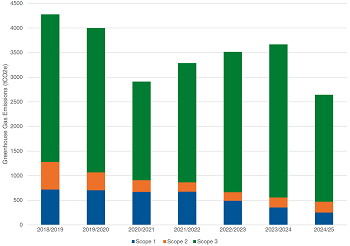
As of 2025, the majority of the council’s emissions now come from the management and operation its leisure facilities, particularly the Aquadrome. At the time of writing the council is progressing work to replace it with a more energy efficient facility that will significantly contribute to the council's carbon neutrality.
The council remains committed to further reducing emissions, particularly in areas that have been hard to tackle to date, to get as close to net zero emissions as possible beyond 2025.
Additionally, the council is always seeking to be as robust and inclusive as possible in carbon reporting. The current carbon footprint does not include some wider scope 3 emissions, such as those from our supply chain. Beyond 2025, the council is also seeking to reduce these emissions, where data is sufficiently available and measurable to track this.
Finally, local government reorganisation is currently proposed within Hampshire. Although the outcomes are not yet clear at the time of drafting, this is likely to result in a new council entity in the future, with a new asset base and operations. As such, existing emissions will need to be re-reviewed at that stage, with an update to the plan to address these.
Borough-wide emissions
Greenhouse gas emissions across the borough continue to reduce year-on-year. The council uses government-published data for monitoring progress, which provides comparability. This is usually published each summer around 18 months in arrears. The latest data available when this strategy was adopted cover 2023. It shows a 5.7% reduction compared to 2022 and a 25.1% reduction compared to 2018 according to the latest government emissions data available when the council drafted this strategy.
The main source of emissions in the borough is transport, covering road (including the M3) and rail transport, accounting for nearly half of all emissions. Heating and powering homes accounts for almost another quarter of emissions.
This downward trend reflects the positive action already under way. The council continues to take a lead where possible, such as through the advice of the Green Team, supporting the transition to electric vehicles with chargers and generating renewable energy on our assets, such as community centres and leisure centres.
However, it is clear the current trend is not fast enough to reach net zero by 2030.
To frame what is required for the borough to reach net zero, the council worked with the Carbon Trust to model potential pathways to reach net zero across Basingstoke and Deane, based on different scenarios. The council and Carbon Trust engaged with stakeholders from across the borough to input into the vision and route map, factoring in their own targets for net zero, and using existing models and projections.
There was very positive engagement from stakeholders, including the NHS, Stagecoach, housing associations, businesses, infrastructure providers and Hampshire County Council.
This work created several scenarios, based on different timeframes to seek to achieve net zero, these being 2030, 2040 and 2045. Each considered the pace and scale of intervention required, including modelled costs and other impacts.
The methodology assumes that borough-wide emissions in 2022 are equivalent to approximately 1,036 kilotonnes of carbon. The overall modelled reduction pathways would see outstanding net emissions reach:
- 680 kilotonnes by 2030, under the scenario where this is the target date;
- 308 kilotonnes by 2040, under the scenario where this is the target date; or
- 185 kilotonnes by 2045, under the scenario where this is the target date.
A ‘business as usual’ scenario was also explored that assumes that no carbon-cutting actions would be taken beyond those that are already under way. This would see outstanding net emissions at 2045 equivalent to 574 kilotonnes of carbon.
The overall modelled emissions reduction pathways are also shown in the graph below.
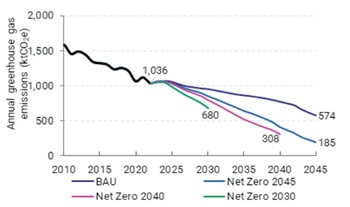
The overall modelled emissions reduction pathways (opens in a new window)
Further detail on the methodology and findings from the work is on our net zero route maps webpage.
This modelling seeks to present ambitious but achievable pathways, based on existing models, as opposed to theoretical requirements. As a result, all scenarios still model a level of residual emissions in the target year, reflecting the need for stakeholders to discuss the most appropriate mechanism to manage emissions that are hard to eliminate.
Even with significant, costly and disruptive interventions in the immediate term, there are significant levels of emissions remaining in 2030.
| Total greenhouse gas emissions in Basingstoke and Deane since 2018 | |
|---|---|
| Year | Emissions
in kilo tonnes |
| 2018 | 1,182.4 |
| 2019 | 1,107.9 |
| 2020 | 967.0 |
| 2021 | 1,014.9 |
| 2022 | 939.3 |
| 2023 | 885.5 |
The data in the table above is also displayed in the graph below.
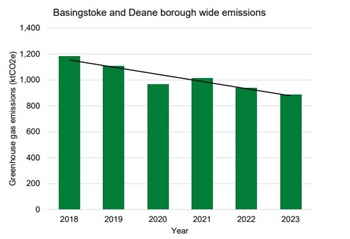
Total greenhouse gas emissions across the borough since 2018 (opens in a new window)
- Sources of greenhouse gas emissions in the borough in 2023
-
- Transport – 47%
- Domestic – 23%
- Agriculture – 9%
- Commercial – 8%
- Industry – 5%
- Waste management – 6%
- Public sector – 2%
Air quality
The council publishes the latest status of air quality as part of its air quality annual status reports. View status reports at www.basingstoke.gov.uk/air-quality.
The main pollutant of concern in Basingstoke and Deane historically has been nitrogen dioxide (NO2). This gas is formed from reactions of nitric oxide (NO) in the atmosphere and collectively these two gases are referred to as NOx. These gases primarily arises from road vehicles and other transport. Generally, concentrations of NO2 are significantly below the annual objective, and levels are steadily declining year on year. This tends to indicate that actions and measures implemented to improve air quality are having a positive effect, both locally and nationally.
Councils are also now required to work towards reducing emissions and concentrations of fine particulate matter (PM2.5 – particulate matter smaller than 2.5 micrometres), which has significant health impacts.
Levels of PM2.5 in Basingstoke and Deane do not currently exceed objective levels set out in national targets. 99% of the council area is also below the target (10 μg/m3 concentration) for 2040. Figures reduced from 9.1 μg/m3 in 2018 to 8.3 μg/m3 in 2023.
However, the council recognises that the World Health Organisation has tighter guidelines PM2.5 and so will continue to proactively target a reduction in these emissions, in tandem with tackling greenhouse gas emissions.
PM2.5 emissions also occur at much higher levels from domestic heating, particularly localised wood-burning. This means approaches to reducing PM2.5 emissions may differ to those for NOx emissions.
Sources of NOx emissions in Basingstoke and Deane
- Roads – 53.7%
- Other – 14.9%
- Other transport – 10.9%
- Domestic and business heating – 12.1%
- Industrial process – 5.3%
- Industrial combustion – 3%
- Waste – 0.2%
Sources of PM2.5 emissions in Basingstoke and Deane
- Roads – 28.3%
- Wood burning – 24.9%
- Waste – 11.1%
- Domestic and business heating – 10.4%
- Other – 8%
- Industrial process – 6.7%
- Other transport – 4.3%
- Agriculture – 3.2%
- Industrial combustion – 3.1%
Additional policy background
There has been plenty of change since the climate emergency declaration and adoption of the council’s Climate Change and Air Quality Strategy in March 2021.
National
The UK has a target to be net zero by 2050, as set out in an amendment to the Climate Change Act 2008 in 2019. There are interim targets for the UK, including a government pledge to reduce emissions by 81% by 2035.
Other significant national policy includes:
- banning the sale of new petrol and diesel cars from 2030. Read the government response to the consultation on phasing out sales of new petrol and diesel cars.
- an aspiration to decarbonise our energy system by 2030, known as Clean Power 2030. Read the government’s Clean Power 2030 action plan.
- the formation of Great British Energy (www.gbe.gov.uk)
- ongoing incentives and grants to support energy efficiency improvements in homes
Relevant legislation related to air pollution includes:
- Air quality strategy: framework for local authority delivery. Read the government Air Quality Strategy
- Environment Act – particularly updates on particulate matter
Local
There have been significant developments locally, with the council leading on a number of areas. The council continues to ensure that tackling the climate emergency runs through all council activity and dovetails with other existing strategies and work, including:
- The Council Plan 2023 to 2027 sets the council’s three overall priorities: a place where people can have pride in their communities and the borough; a borough where we protect, restore, reconnect and enhance our natural environment; and a council that delivers high- quality services for our residents.
- A Local Plan provides the planning policy framework to achieve sustainable development to create places people want to live, work and locate businesses. The plan covers all types of development, from housing to shops, including a range of planning policies to inform the location, scale, and appearance of developments. The council’s Local Plan, which was adopted in 2016, is currently being updated to ensure it remains up to date and delivers national and local objectives. A key objective of the new plan is to ensure new development minimises environmental and climate impacts.
- The council declared an ecological emergency in October 2021 which recognises the urgency of the situation and the need to take action. The Biodiversity Strategy was approved in March 2024, outlining how the council, working with partners, will support nature recovery in the borough and tackle the ecological emergency.
- The Green Infrastructure Strategy provides the framework for the management of the interconnected network of natural areas, habitats and other green open spaces across the borough. This strategy is being updated in 2026 to a blue and green infrastructure strategy.
- The council’s Tree Policy sets out how the council will manage its own tree stock, deal with dangerous privately owned trees, protected trees and trees affected by development proposals and is due to be updated in 2026.
- Reducing emissions from transport including working with partners such as Hampshire County Council as the body responsible for local roads, footpaths ad cycle ways is an key area. The Transport Strategy sets overall aims here, supported by the Electric Vehicle Charging Strategy. The Local Cycling and Walking Infrastructure Plan outlines the strategic approach to identifying cycling and walking improvements required at the local level.
- Supporting local businesses to grow in a sustainable way and to tackle their carbon footprints is a key part of the council’s Future Economy Framework.
There are plenty of overlaps with the council’s works to improve health and wellbeing in the borough, with specific examples including shifts towards active and public transport.
Kerbside food waste collections from households began in October 2025. Cabinet has agreed that household waste and recycling collections will happen every other week from October 2026.
Finally, devolution and local government reorganisation are currently proposed for Hampshire. Although the outcomes are not yet clear at the time of drafting, this reorganisation has the potential positive opportunity of having services delivered by an “all-under-one-roof” council.
Strategic partners and other context
Strategic partners
Given collaboration with partners is a key aspect of this strategy, their targets, strategies and aspirations are important to acknowledge.
- Housing associations including SNG and Vivid, which aim to reach net zero by 2050. View Vivid’s energy and sustainability strategy and SNG’s Environmental Sustainability Strategy.
- NHS Hampshire Hospitals Trust has a green plan that aims to embed sustainability across all areas. The trust currently aims to begin construction of a new hospital for north Hampshire between 2037 and 2039.
- Hampshire County Council has a climate change and air quality action plan. Its approach is embedded in its local transport plan (LTP4) and local cycle and walking infrastructure plans for the area. It also has a public health strategy with support to tackle climate change and air pollution.
- Distribution Network Operator SSEN Distribution is supporting the UK Government's target of delivering Clean Power by 2030 and has an environmental action plan, a climate resilience strategy and a sustainability strategy, while SGN has its own environmental strategy.
- South East Water targets net zero by 2030 and Southern Water by 2050. Thames Water has a sustainability policy.
- South West Railway targets being a net zero operator by 2040.
- Stagecoach targets a net zero bus fleet by 2030 and a net zero organisation by 2050.
- Local further education colleges Queen Mary College and Basingstoke College of Technology are taking steps to become more sustainable. The latter runs a ‘green skills centre’ offering tradespeople training to install and maintain renewable technologies.
Other context
The council recognises that lots of great activity and action is already happening alongside and outside its endeavours.
There is already local community action within the borough, supporting residents and communities to take action. The council endorses this and wants to support where it can. The Basingstoke Area Sustainability forum is a regular meeting to support these groups and enable shared learning. Find information about the Basingstoke Area Sustainability forum on the Sustainable Basingstoke website.
Groups include: Greener Basingstoke, Sustainable Silchester, Sustainable Baughurst, Sustainable Overton, Greener Kingsclere, Natural Basingstoke, Wilder Bramley, Oakley, and Green Homes Bramley, to name a few. Faith groups are also taking action, alongside the seven repair cafes in the borough.
There are also community energy societies active in the borough looking to promote renewable energy that benefits the local community.
The council’s approach to action
We recognise there are levels of control and influence that we can use to drive action, considering our role as a borough council, and the responsibilities of other tiers of local government (most notably Hampshire County Council that is responsible for areas such as local transport infrastructure and waste disposal). Therefore, we have adopted the following approach to taking action on climate change:
- Lead by example by tackling our own emissions, particularly by reaching carbon neutrality by 2025
- Enable a net zero carbon borough through key policies, standards and enforcement. Some of these will have a significant role in addressing carbon emissions
- Inspire action across the borough. We cannot achieve these targets without support and change from residents and businesses
Actions are grouped in six main areas:
- Action by all – the need for everyone in the borough to contribute
- Buildings – tackling emissions from heating and powering our buildings
- Transport - tackling emissions from vehicles
- Zero carbon electricity – supporting the transition to a decarbonised electricity system
- Consumption and waste – reducing waste and consumption
- Natural environment and offsetting – maximising the climate mitigation and adaptation qualities of the natural environment
Specific actions are set out in the supporting action plan. This provides more information and detail on action under way, categorised as above, and recognises the role of the council and when responsibility for delivery sits elsewhere.
We will report on progress against the action plan and carbon emissions annually through the council committee structure. Further detail on the categories, and a summary of proposed action, is below:
- Action by all
-
This category underpins all action in the strategy as we seek to encourage others to take action and work alongside groups, communities and organisations, including those already working to tackle climate change.
Leading by example
- The council is leading by example by embedding climate action throughout the council, including through training, education and decisions.
Enable and inspire
- We will support residents, communities and organisations to take action through advice, engagement and information, including our existing toolkits and the work of the Green Team throughout the borough.
- Seek to communicate in an engaging and positive way, including through the Sustainable Basingstoke initiative, leading with benefits other than cutting carbon in situations when audiences may be better motivated by them, for example, saving money or improved health outcomes.
- Lobbying for further policy change and support, particularly from government
- Buildings
-
This area relates to the energy consumption, both heat and power, of buildings within the borough, most of which still comes from burning fossil fuels. We must reduce this energy consumption and use low or zero carbon sources of heat and power.
Leading by example
- Reducing emissions from our own buildings by improving energy efficiency and using low carbon or renewable energy sources where possible.
Enable and inspire
- Setting ambitious planning policies to minimise carbon emissions from new development, including through the delivery of highly sustainable new buildings, and measures to ensure the borough is resilient to the effects of the changing climate.
- Using specific influence we have for some buildings, such as community buildings/investment portfolio to reduce building energy consumption.
- Support residents through the transition, particularly to low-carbon heating, including through the Green Team, alongside looking to tackle fuel poverty.
- Work with partners on opportunities for wide-scale retrofit and regeneration.
- Transport
-
Transport accounts for around half of the greenhouse gas emissions in the borough and significant air pollution, particularly from fine particulate matter and nitrogen dioxide. Tackling these emissions will require significant reduction in road journeys and move to public transport, complemented by the move to ultra-low emission vehicles.
Leading by example
- Promoting efficient travel of council staff through internal policies and incentives.
- Transitioning council fleet to ultra-low emission vehicles and reduce mileage of services where possible.
Enable and inspire
- Building on the plans within existing transport strategy, working in collaboration with Hampshire County Council and other partners
- Promoting a move to public transport, active transport and electrification of transport (or other ultra-low emission technologies), as well as minimising the need for travel through planning policy
- Particular targeting of air quality issue areas or high-risk areas, such as schools
- Campaigns to educate against behaviour that causes air quality issues
- Zero carbon electricity
-
The national electricity grid has made reasonable progress in decarbonising over recent years. This is expected to accelerate, in order to keep up with increased demand as transport and heat become increasingly electrified. There are important opportunities for us in the borough through being involved in strategic energy planning. The council would like to see local renewable energy generation that brings benefits to local communities.
Leading by example
- Utilising renewable energy to power our own buildings.
Enable and inspire
- Work with strategic infrastructure providers within the borough, particularly SSEN, to ensure the borough is supporting national decarbonisation and the move to a smart and more flexible electricity system.
- Support local and community energy, such as through sharing of best practice and identifying funding opportunities.
- Local Plan Update to support proposals for renewable and low carbon energy in suitable locations, including on existing buildings and structures
- Consumption and waste
-
The goods and food we use and consume all have a carbon footprint, even if these emissions occur overseas where goods are manufactured. Reducing our consumption and waste generated is important locally and internationally.
Leading by example
- Seeking to reduce emissions from our supply chain and support suppliers to reduce their emissions.
Enable and inspire
- Education on lower carbon lifestyles, such as diet
- Facilitating transition to more circular economy, with positive impacts for local job creation and investment
- The natural environment
-
Tackling climate change and the ecological emergency must go hand-in-hand.
As mentioned, climate change is already having a detrimental impact on biodiversity, yet the natural environment has a vital role in tackling climate change, such as locking up thousands of tonnes of carbon a year and providing natural resilience. The role of the natural environment in adapting to future climate change is also essential, given the current and future impact of climate change in the borough. This area is especially connected to the council’s biodiversity strategy which seeks to help ensure the protection and enhancement of habitats within the borough, which can contribute to climate change mitigation and adaptation.
Leading by example
- Continuing to effectively manage council-owned green spaces for nature, creating or enhancing this to improve carbon lock-up where possible, while balancing this against biodiversity requirements.
Enable and inspire
- Promote improvement of local natural environment in the borough, for carbon lock up alongside wider societal and natural benefits
- Further develop and strengthen policies for the protection and enhancement of the natural environment to support climate change adaptation and resilience, such as through the updated Local Plan and forthcoming Blue and Green Infrastructure Strategy
- Supporting utilisation of green finance mechanisms, alongside landowners and businesses, to promote and deliver nature recovery
- Securing gains for biodiversity through the planning system, including protection of existing important habitats and implementing new green infrastructure for people and wildlife, such as new parks and extra tree and hedgerow planting
Collaboration
Given emissions are the result of the activities that our residents, business and visitors undertake, it is important to work with them, as well as other stakeholders, to support and encourage action in support of the borough council’s ambition to tackle climate change and reach net zero.
The council began working with others to cut emissions even before it declared a climate emergency in 2019, collaborating on individual projects and more strategic initiatives. This recently included stakeholders supporting and contributing to a vision for, and pathway to, a net zero borough through a project with the Carbon Trust that has helped to shape this strategy.
The council will continue to engage and collaborate with partners, including:
- Strategic organisations that have a role in influencing and supporting residents and businesses, such as the local housing associations, NHS, Hampshire County Council, businesses and colleges;
- At a more local level, those community and interest groups that have formed and which represent an important grassroots-level of detailed knowledge and enthusiasm who are able to engage with residents on issues of importance to them, such as Greener Basingstoke and those that form the Basingstoke Area Sustainability forum.
Through these connections and relationships, in addition to the Green Team, there is real scope to make a difference, to implement actions and, where appropriate, submit funding bids to secure investment to benefit residents and businesses. Very often this can have joint benefits, both in terms of climate change, but also where a project can support the natural environment, health and well-being as well as active travel.
Communication and engagement
Regular, effective and proactive communication on environmental and climate change matters underpins the council’s actions and approach set out in this strategy.
Focusing on such co-benefits is central to the council’s approach to communicating about climate change and nature and driving behaviour changes by communities and companies that tackle the twin emergencies. By frequently highlighting the other benefits of climate and nature-positive actions – for example, the financial savings of installing solar panels – in its communications, the council aims to encourage personal and public support for and take-up of such initiatives among a range of people and businesses.
Achieving and implementing our net zero goal
The target date of 2045 to reach a net zero borough remains ambitious, particularly in light of the overall target established by the Government and the challenge of dealing with residual emissions by this date. Nonetheless, the council recognises the need to aim high, given the importance attached to address our climate emergency.
Below we have set out some indicators of progress, based on the detailed work undertaken by the Carbon Trust. These will be monitored and progress presented as part of reporting against this strategy and accompanying action plan.
This will allow actions and priorities to be amended, as need be, as well as providing a means of lobbying for change with others.
Route map to a net zero Basingstoke and Deane by 2045
- By 2025
-
- 6,500 vehicle chargers installed
- 7% private cars are electric
- 3 megawatts of rooftop photovoltaic solar panels
- 1,500 new heat pumps installed in buildings
- 28% waste recycling rate
- 3% of industrial heat demand electrified
- 1% decrease in livestock emissions
- By 2030
-
- 23,300 vehicle chargers installed
- 27% private cars are electric
- 5% buses are electric; 5% run on hydrogen
- 16 megawatts of rooftop photovoltaic solar panels
- 3,000 new heat pumps installed in buildings
- 56% waste recycling rate
- 2% homes with new retrofit measures
- 13% of industrial heat demand electrified
- 7% decrease in livestock emissions
- By 2035
-
- 48,000 vehicle chargers installed
- 51% private cars are electric
- 16% buses are electric; 25% run on hydrogen; 8% run on biofuels
- 30 megawatts of rooftop photovoltaic solar panels
- 6% of heavy goods vehicles (HGVs) run on hydrogen
- 11,000 new heat pumps installed in buildings
- 2 megawatt solar canopy installed
- 65% waste recycling rate
- 12% homes with new retrofit measures
- 26% of industrial heat demand electrified
- 13% decrease in livestock emissions
- By 2040
-
- 72,800 vehicle chargers installed
- 72% private cars are electric
- 32% buses are electric; 37% run on hydrogen; 10% run on biofuels
- 43 megawatts of rooftop photovoltaic solar panels
- 11% of heavy goods vehicles (HGVs) run on hydrogen
- 39,000 new heat pumps installed in buildings
- 4 megawatt solar canopy installed
- 66% waste recycling rate
- 50% homes with new retrofit measures
- 36% of industrial heat demand electrified
- 16% decrease in livestock emissions
- By 2045
-
- 87,800 vehicle chargers installed
- 84% private cars are electric
- 46% buses are electric; 44% run on hydrogen; 10% run on biofuels
- 55 megawatts of rooftop photovoltaic solar panels
- 29% of heavy goods vehicles (HGVs) run on hydrogen
- 67,000 new heat pumps installed in buildings
- 6 megawatt solar canopy installed
- 67% waste recycling rate
- 87% homes with new retrofit measures
- 42% of industrial heat demand electrified
- 19% decrease in livestock emissions
Principles of delivery
Finally, as a council, we will continue to adhere to a number of guiding principles in our approach to tackling climate change.
- Prioritise – where possible, actions that deliver the most significant carbon impact will be prioritised, taking into account other key work areas and availability of funding
- Lobby – we know that action to tackle climate change requires significant local and national action and so the council will lobby, as and where appropriate, for the required power, funding and policy to drive the action we think is required
- Collaborate – working alongside, supporting and challenging our partners, communities, and businesses to go further
- Adapt – taking a flexible approach to how we enable and inspire action that reflects updates to national and local policy, the emergence of new low-carbon technologies and people’s and organisations’ different and changing opinions, attitudes and ambitions around tackling the climate crisis
- Be data-led but pragmatic – decisions and monitoring will be based on best available data and evidence. There are limitations in some datasets, such as lags in publication of national data, and we will continue to improve data collection for the council activities. Decisions must be based on robust data but we do not want to delay beneficial actions and so will take a proportional and sensible approach
- Explore all options, including offsetting residual emissions – reducing and eliminating greenhouse gas emissions remain the priority of this strategy. However, it is acknowledged that some emissions will be extremely challenging or not possible to eliminate entirely and so a mechanism to deal with these will be required. Use of natural and local offsets that bring additional co-benefits will be preferred, where robust arrangements are in place
Sign up for email updates
Receive information on council services, news and events by email.
Subscribe© 2026 Basingstoke and Deane Borough Council